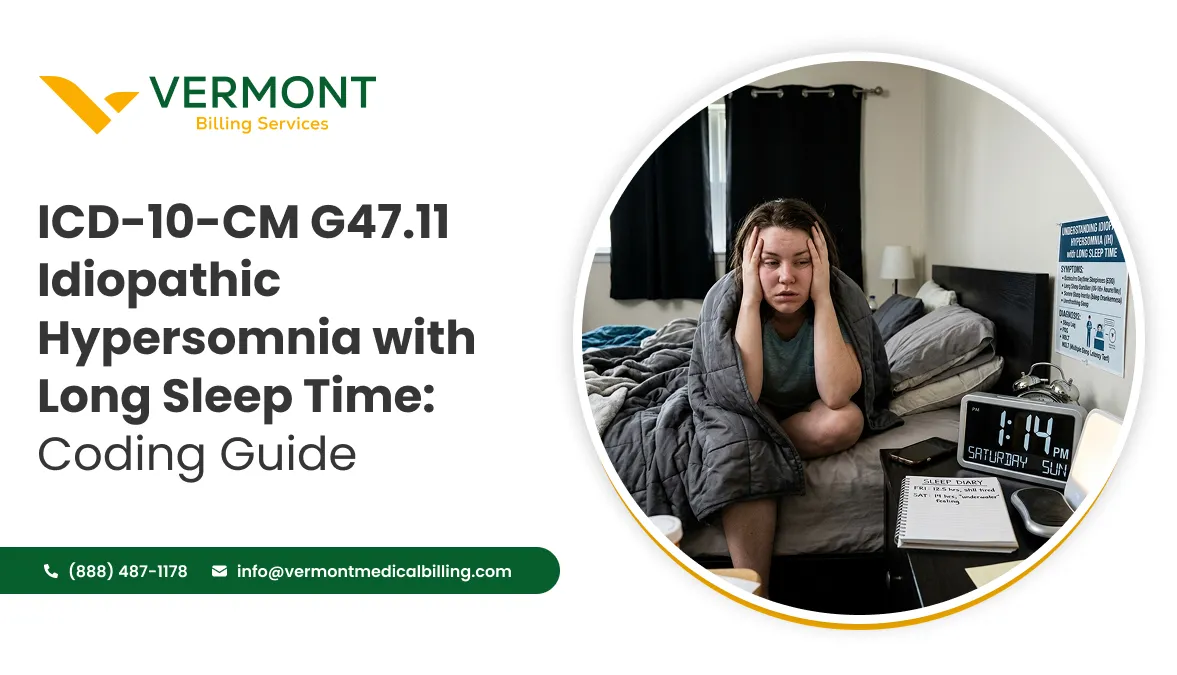
Excessive daytime sleepiness does not always result from insufficient sleep. Some people sleep for times and still find it hard to stay awake during the day. When a sleep specialist finds hypersomnia choosing the right diagnosis code is a key part of writing down the condition and helping with medical claims.
The G47.11 ICD-10 code is used for hypersomnia with long sleep time. To use this code you need more than just a patient telling you that they sleep a lot or feel very tired during the day. Doctors must prove the diagnosis note the clinical findings and separate idiopathic hypersomnia from other disorders that also cause excessive sleepiness.
This guide tells you when to use G47.11, what documentation matters, how it is different, from hypersomnia codes and what doctors should check to avoid avoidable billing mistakes.
What Is ICD-10-CM Code G47.11?
ICD-10-CM G47.11 is a code that can be used for billing purposes. It is used for a diagnosis called hypersomnia with long sleep time. This code is part of the group G47.1. That group deals with hypersomnia disorders. These disorders are part of the chapter on diseases of the system.
Idiopathic hypersomnia is a type of disorder that affects the nervous system. It causes sleepiness that does not get better even when a person has enough sleep. There is no reason for the sleepiness. The cause is not known. People with this condition may sleep for a long time, at night. They may have trouble waking up. They may still feel sleepy even when they have had rest.
The following table outlines the classification of G47.11.
| Coding Detail | Description |
|---|---|
| ICD-10-CM Code | G47.11 |
| Official Description | Idiopathic hypersomnia with long sleep time |
| Parent Category | G47.1 – Hypersomnia |
| Code Category | G47 – Sleep disorders |
| ICD-10-CM Chapter | Diseases of the nervous system |
| Billable Status | Billable and specific |
| Inclusion Term | Idiopathic hypersomnia NOS |
One important point is that the classification also includes hypersomnia not otherwise specified under G47.11. That means the code may apply when a provider documents hypersomnia without naming the long‑sleep subtype.
Coders should refer to the official ICD‑10‑CM Alphabetic Index and Tabular List than assuming that the code title demands an explicit statement of long sleep time in every case.
When Should Healthcare Providers Use G47.11?
Healthcare providers should report G47.11 when their clinical assessment confirms hypersomnia with long sleep time or another documented diagnosis that is indexed to this code.
The diagnosis usually comes after an evaluation of persistent excessive daytime sleepiness sleep patterns and possible underlying causes.
To code this condition accurately the medical record must clearly show that:
– The provider has diagnosed hypersomnia.
– The clinical assessment supports the diagnosis.
– Relevant sleep history and diagnostic findings are properly documented.
– Other possible causes of sleepiness have been assessed in a way that is clinically appropriate.
Physicians should not assign G47.11 just because a patient says they sleep longer than usual.
For instance a patient who sleeps 11 hours a night and still feels tired should undergo evaluation. Sleeping longer, than normal does not by itself mean the person has hypersomnia.
The final diagnosis must be based on the treating provider’s judgment not on assumptions made from symptoms or test results alone.
Clinical Findings Associated With Idiopathic Hypersomnia
Patients with idiopathic hypersomnia often experience excessive daytime sleepiness despite having adequate opportunities to sleep.
The condition can interfere with daily activities, workplace performance, and the ability to maintain normal wakefulness.
Common clinical findings include:
Persistent daytime sleepiness: Patients struggle to remain awake or alert during normal daytime activities, even after what appears to be sufficient nighttime sleep.
Prolonged sleep duration: Some patients regularly sleep for extended periods, sometimes exceeding 11 hours in a 24-hour period.
Difficulty awakening: Patients may experience pronounced sleep inertia, including confusion, disorientation, or reduced alertness after waking.
Unrefreshing naps: Unlike patients with some other sleep disorders, individuals with idiopathic hypersomnia may not feel noticeably refreshed after daytime naps.
Functional impairment: Persistent sleepiness may affect concentration, work responsibilities, education, and daily routines.
Although these findings support the clinical evaluation, they are not exclusive to idiopathic hypersomnia. Physicians must consider other sleep disorders, medication effects, and medical conditions before establishing the diagnosis.
Documentation Requirements for G47.11 ICD-10 Coding
Clear clinical documentation helps medical coders identify the diagnosis. It also gives payers the information they need to review necessity.
For practices treating patients with sleep disorders the following documentation elements deserve attention.
1. Record the Confirmed Diagnosis
The doctors evaluation should notice hypersomnia when the testing shows that is the case.
Notes, like ” much sleepiness” or “maybe hypersomnia” don’t prove that someone has idiopathic hypersomnia.
For office visits if the diagnosis is not clear and is called probable, suspected or under consideration it usually can’t be used as a confirmed condition. Instead doctors should list the symptoms or other information that was found during the visit.
2. Document Sleep History and Diagnostic Findings
A detailed sleep history can help distinguish idiopathic hypersomnia from insufficient sleep and other causes of hypersomnolence.
Relevant documentation may include:
- Average nighttime and total daily sleep duration.
- Duration and frequency of excessive daytime sleepiness.
- Sleep diaries or actigraphy findings.
- Polysomnography results, when performed.
- Multiple Sleep Latency Test (MSLT) findings, when applicable.
- Additional sleep assessments used to establish the diagnosis.
Sleep specialists may use overnight polysomnography and MSLT as part of the evaluation. Extended sleep monitoring may also help document prolonged sleep duration.
Not every patient will have identical test findings. Clinical diagnostic criteria, test limitations, and the patient’s history should guide the physician’s assessment.
3. Evaluate Other Causes of Sleepiness
The word idiopathic means that the disorder does not have a cause that can be explained by another known condition.
Because of this healthcare providers must carefully check for possible reasons that could be causing the symptoms. These include things like sleep apnea not getting enough sleep problems with the body’s natural sleep-wake cycle, side effects from medications and narcolepsy.
For example someone with obstructive sleep apnea might feel very sleepy during the day. If a provider calls the condition hypersomnia without first ruling out these other causes it can make the diagnosis unclear. It may lead to confusion, about what’s really happening. That’s why it’s important to do an evaluation before saying a condition is idiopathic.
4. Describe the Effect on Daily Functioning
Clinical records should describe how symptoms affect the patients life when relevant.
Writing down trouble waking up trouble focusing or problems, with tasks helps show how serious the condition really is.
These details can also help prove why more tests or treatment are needed, especially when the insurance company or payer requires that kind of proof.
G47.11 vs. Other Hypersomnia ICD-10 Codes
Not every hypersomnia diagnosis belongs under G47.11. ICD-10-CM provides several codes that distinguish different forms and causes of excessive sleepiness.
| ICD-10-CM Code | Diagnosis |
|---|---|
| G47.10 | Hypersomnia, unspecified |
| G47.11 | Idiopathic hypersomnia with long sleep time |
| G47.12 | Idiopathic hypersomnia without long sleep time |
| G47.13 | Recurrent hypersomnia |
| G47.14 | Hypersomnia due to medical condition |
| G47.19 | Other hypersomnia |
What Is the Difference Between G47.11 and G47.12?
Both codes refer to hypersomnia but ICD-10-CM separates them based on the long-sleep classification.
G47.11 is for hypersomnia with long sleep time. It also includes hypersomnia NOS.
G47.12 is for idiopathic hypersomnia, without long sleep time.
The correct code depends on what the physician has documented in the diagnosis. Coders should not decide on a subtype by looking at how many hours the patient sleeps. That’s not enough.
If the medical record has mixed or unclear information about which subtype was diagnosed it’s best to ask the provider for clarification.
When Is G47.10 More Appropriate?
G47.10 describes hypersomnia.
This code can be used when a provider confirms hypersomnia but does not find a specific type that can be coded.
However coders must not automatically use G47.10 if the recorded diagnosis is hypersomnia NOS. The ICD-10-CM classification directs that diagnosis, to G47.11.
Choosing a code that matches the providers diagnosis keeps specificity from being lost unnecessarily.
Common G47.11 Coding and Billing Errors
Sleep disorder claims can run into trouble if the diagnosis does not match the notes or the services that were billed.
Sleep disorder claims face issues that are especially relevant, to G47.11.
Coding Symptoms as a Confirmed Diagnosis
Excessive daytime sleepiness is a feeling that shows up in medical conditions and it can be a sign of a deeper problem.
Issuing the code G47.11 before the doctor has proven hypersomnia can result in a diagnosis code that is not supported. This practice can create confusion.
To avoid this problem look at the assessment. Separate confirmed diagnoses, from symptoms and conditions that are still being checked and keep the record clear.
Confusing Idiopathic Hypersomnia With Narcolepsy
Narcolepsy and idiopathic hypersomnia both cause tiredness during the day. They are not the same. They have signs and ways doctors figure them out.
You should not mix them up just because they feel similar. One is not a replacement, for the other.
How to avoid confusion: Stick with the sleep specialist’s diagnosis. If you’re unsure go back. Check the test results they recorded. That helps make sure you get the one.
Choosing the Wrong Hypersomnia Subtype
Confusion between G47.11 and G47.12 can happen if a medical record does not clearly explain how long a patient sleeps.
To avoid confusion, between G47.11 and G47.12 I use the official coding classification and request clarification when the providers diagnosis and supporting documents do not match.
Missing Medical Necessity Documentation
A valid ICD-10-CM code does not automatically mean that sleep testing will be covered. It also does not guarantee that treatment or follow-up services will be covered.
Payers might ask for records that explain why a certain service was needed.
How to avoid problems: Make sure the medical record shows that the service ordered was needed. Check that the service meets the rules set by the payer for necessity.
Overlooking Payer Requirements
Some sleep studies, treatments or prescribed medications may need authorization or extra paperwork depending on the patients insurance plan.
How to avoid denial: Review coverage requirements, before sleep studies, treatments or prescribed medications are. Confirm that the claim shows the documented diagnosis.
Good practices can reduce rework by spotting these issues before submission instead of after a denial.
G47.11 ICD-10 Coding Example
Here are some scenarios that show how the notes a provider writes can change the codes used.
Example: Confirmed Idiopathic Hypersomnia
A 34‑year‑old patient goes to a sleep expert because the patient feels very sleepy during the day and has trouble getting out of bed.
The patient says the patient sleeps for a time at night but still does not feel refreshed. The sleep specialist looks at the patient’s sleep history checks, for possible reasons and orders the right tests.
After looking at all the results the specialist says the patient has hypersomnia with long sleep time.
Appropriate ICD-10-CM code: G47.11
The provider has established a diagnosis that matches the official code description. The clinical record contains supporting information from the evaluation.
How Accurate G47.11 Coding Supports Medical Billing
For sleep medicine practices diagnosis coding influences more than the data shown on a claim.
An accurate diagnosis links the patient’s condition, to the services offered. Provides insurance reviewers with a clearer picture of the treatment.
When billing teams use correct diagnosis coding for hypersomnia with the ICD‑10 code they can solve several common revenue cycle concerns.
Accurate claims: When I report the established diagnosis I reduce coding inconsistencies, between the clinical record and the claim that I submit.
Medical necessity support: When I document symptoms, diagnostic assessments and treatment decisions I help explain why the services were performed.
Avoidable denials: By reviewing diagnoses and payer requirements before I submit I can prevent some documentation‑related denials and requests for extra records.
Efficient claim follow‑up: When I keep complete records billing staff can respond more effectively when payers ask for medical documentation.
Vermont Medical Billing sees how important it is to align diagnosis codes with records and fast claim handling. For providers who handle sleep disorder claims focusing on these details can cut admin stops. Keep billing steady.
Still using G47.11 correctly does not promise payment. Coverage depends on benefits, medical need, payer rules and services listed.
Frequently Asked Questions About G47.11
What does ICD-10-CM G47.11 mean?
G47.11 identifies idiopathic hypersomnia with long sleep time. The condition involves persistent excessive daytime sleepiness and may include prolonged sleep duration and difficulty awakening. The code also includes idiopathic hypersomnia NOS.
Is G47.11 a billable ICD-10 code?
Yes. G47.11 is a billable and specific ICD-10-CM diagnosis code that healthcare providers can report on medical claims when supported by the documented diagnosis. It remains valid for fiscal year 2027.
What is the difference between G47.11 and G47.12?
G47.11 identifies idiopathic hypersomnia with long sleep time, while G47.12 identifies idiopathic hypersomnia without long sleep time. The official coding classification also assigns idiopathic hypersomnia NOS to G47.11.
Can G47.11 be assigned without a sleep study?
ICD-10-CM does not impose a universal requirement that every claim containing G47.11 include a sleep study.
For outpatient coding, the provider must establish the diagnosis. Clinical diagnostic standards may require objective sleep evaluation, while insurers may request specific supporting records for covered services.
Coders should not independently diagnose idiopathic hypersomnia or infer it from symptoms when the provider has not established the condition.
Is idiopathic hypersomnia the same as narcolepsy?
No. Although both conditions involve excessive daytime sleepiness, they are distinct sleep disorders with different diagnostic characteristics.
Narcolepsy may involve features such as cataplexy and characteristic sleep-testing findings. Idiopathic hypersomnia often involves prolonged sleep, severe sleep inertia, and unrefreshing naps.
Physicians should diagnose and document the specific condition before the coding team selects the corresponding ICD-10-CM code.
Can G47.11 be used as a primary diagnosis?
Yes. G47.11 may be reported as the first-listed diagnosis when idiopathic hypersomnia is chiefly responsible for the outpatient services provided and the documentation supports that selection.
Diagnosis sequencing depends on the circumstances of the encounter and applicable coding guidelines.
Conclusion
Accurate use of G47.11 ICD-10 starts with a confirmed diagnosis and documentation that clearly explains the patients sleep disorder. Doctors need to tell the difference between hypersomnia and other reasons for too much sleep while medical coders need to use the official classification when choosing between similar hypersomnia codes.
For healthcare practices, regular documentation and correct diagnosis reporting can help avoid coding mistakes make it easier to show necessity and make claim reviews simpler.
Vermont Medical Billing helps healthcare providers with billing and revenue cycle services helping practices keep accurate claims and deal with billing problems without making more work, for the staff.